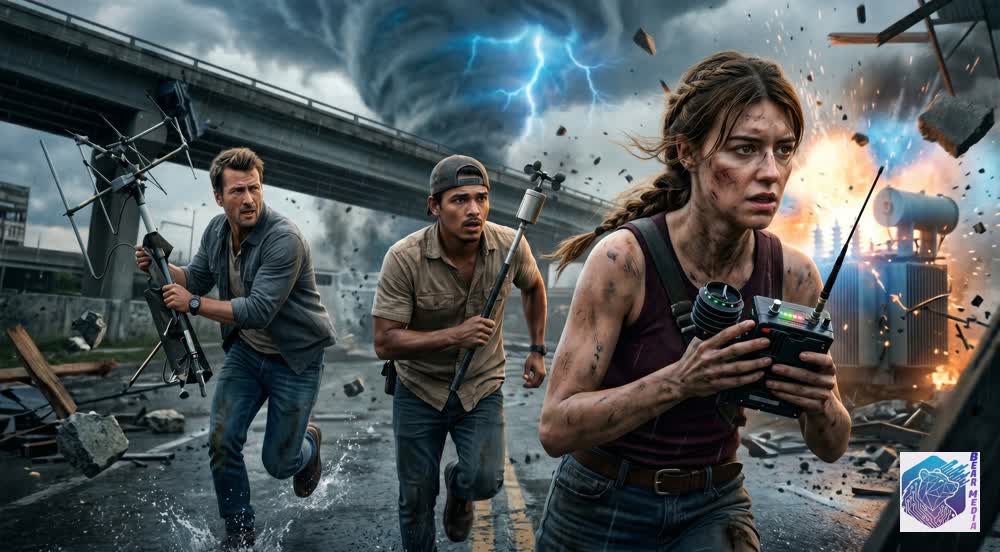
Daisy Edgar-Jones, Glen Powell, Anthony Ramos.
Action | Thriller | Disaster
“To measure the fury, you must first survive the silence.“
The city has a memory written in steel and shadow. Decades-old structures of ambition stand against a sky that is too still, an air that is too quiet, a warning sign for those who know to listen. The dust has settled on past triumphs, on equipment that once chased ghosts, but some memories don’t fade, they just wait. Now, the atmosphere begins to hum with an echo of a previous storm, a cycle returning to claim its space, and three people find themselves on the fault line of a memory that is about to become flesh.
Daisy Edgar-Jones – Whispers of the Binary. Her face is a map of focused intent, looking out over the precipice where data ends and chaos begins. She holds a sophisticated, blinking radio, a tool not of measurement, but of communion. For her, the storm is a puzzle box of a specific, ancient signal she’s been trying to decode. Her study is an obsession born from a distant loss, a need to predict, to control, to find a pattern in the divine madness. But as the readings on her device begin to spike, they don’t give answers, they just count down the seconds until her logic fails. She must learn that sometimes, to understand the storm, you have to stop looking at the screens and start feeling the crackle in the air.
Glen Powell – Legacy’s Grip. He is the brute force that supports the theory, physical action battling a metaphysical force. While Daisy looks to the binary, his hands are calloused from wrestling with the machines, trying to hold a complex antenna array steady on the roof of their chase vehicle. He looks back not in fear, but with a calculated, visceral dread, a connection to the storms that is practical and immediate. He is the physical keeper of a history, the one who saw the original systems rise, and he understands that the old billboard still standing in the distance isn’t just advertising a past life; it’s a marker of how some forces cannot be silenced. He is the anchor to a ground that is about to give way, trying to build a shelter in a storm that can unbuild worlds.
Anthony Ramos – The Tipping Point. He is the link between data and feeling, holding a humble anemometer that measures a wind speed but not its weight. New to this direct, brutal force, he is the innocent among the veterans. He hasn’t seen the devastation, hasn’t felt the specific cold of a city being consumed. At first, it’s about the mission, the data collection, a scientific exercise with a pulse. But as he looks up, his perspective shifts from numbers to terror. He is the one who will see the storm first, the first to look into its electrified, ancient eyes and realize that they are not measuring a wind event; they are witnessing a birth of a force that makes calculation irrelevant.
The cracks are where the light used to get in. Now, they are where the wind begins its call.
The force that descends is not a weather pattern; it is a primal presence. The new supercell forms over the metropolis with terrifying intelligence, its core pulsing with a blue, lightning-charged energy that defies natural law and scientific expectation. The city itself is the field of battle, a fragile human playground that this monster is preparing to unmake. They are not chasing the storm; it has found them, a localized recurrence that has lain dormant, a historical memory given life. This storm isn’t a force to be studied; it is a question that requires an answer they cannot find in their computers. “NEW SUPERCELL THREATENS METROPOLIS; PIONEERS RETURN TO EYE OF THE STORM.“
One chance to listen to the silent engine. One chance to find the eye before it blinks.
The city goes dark. The computers fail, the screens of data on Daisy’s radio go dead. Glen’s intricate antenna rig is ripped away, their communication link becoming the last, final strand of human connection. The storm is overhead, consuming the sky, and they are trapped on the ground in a maze of collapsing steel and flying debris, where an old billboard and cars become deadly missiles. Their only hope is no longer scientific prediction, but raw, unfiltered human intuition. It’s Daisy’s face of absolute, focused gaze that is the true sensor now, looking past the dead technology to a place inside herself where the data of memory and instinct merge. They must trust each other when every measurement tells them to panic.
A perfect prediction of an impossible truth. Faith, measured in seconds, before the ground gives way.
They do find the eye. Not with data, not with an algorithm, but with a singular, quiet understanding born of shared dread and intuition. They survive. But the ending is not a simple escape. The sky is clear, but changed. The city’s silence after the maelstrom is profound. Their sophisticated equipment is gone, their base is a wreck. But as the final quiet descends, a small, blinking light on Daisy’s radio (which is now just a useless shell of tech) begins to pulse with a steady, regular beat, not a complex data signal, but a simple, repeated code of survival, a heartbeat in the silence. It is the silent engine they had to find, a measure of hope. And in the final frame, we see the old Twister billboard still standing, its image of the previous generation intact, while on the adjacent ground, a single, delicate green sprout pushes through the fractured concrete of the urban debris field, a quiet testament to the enduring rhythm of new life after a primal force. A single, clear signal of survival.
-
Resilience and the absolute power of human intuition over technology.
-
The cyclic nature of primal forces and the enduring echo of a shared past.
-
The limits of scientific measurement when confronted by a force that can only be felt.
-
Legacy, memory, and the enduring rhythm of rebirth after the storm.
If you know the end is a storm, do you start to look for the eye inside yourself?
The memory of the wind is a song we all know. The memory of the wind is a song we all know.
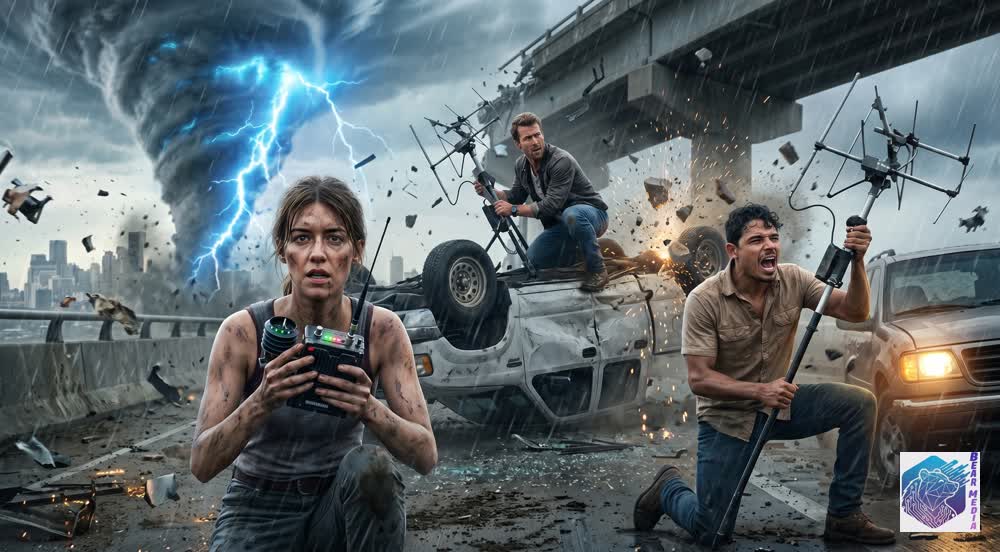
The wind has passed, but the air will never be still for them again. They leave behind the tools of measurement, the machines of calculation, the need to predict. They step out of the wreckage with a new data point, one that no screen can register but every human heart understands: the knowledge of what it means to be silent and to truly hear.
★★★★☆ A film that doesn’t just show the storm; it invites you to listen to it.